
Best Fine Motor Skills Activities For Toddlers

📖 Table of Contents
- The Power of Playdough for Fine Motor Skills
- Sorting and Matching: A Brain-Boosting Activity
- Using Tongs and Tweezers for Precision
- The Benefits of Threading and Lacing Activities
- Building Blocks and Stacking: A Foundation for Development
- Make It Your Way
- Frequently Asked Questions
- The Printable Activity Plan
When my daughter turned two, I realized how much of her development was tied to her ability to manipulate small objects. Fine motor skills were not just about picking up a crayon or buttoning a shirt — they were the invisible scaffolding that supported her confidence, creativity, and cognitive growth. That’s when I started hunting for the best fine motor skills activities for toddlers that would be both fun and effective. What I found was a treasure trove of simple, low-cost, and highly engaging options that transformed our home into a playroom of learning.[2]
Fine motor skills are the foundation of a child’s ability to write, dress, eat, and interact with the world. As a parent, I quickly learned that these skills don’t just develop on their own — they need deliberate practice, repetition, and a variety of activities that challenge small hands and minds. My biggest revelation was that the best fine motor skills activities for toddlers are the ones that don’t feel like work. Whether it was threading pasta onto a string or stacking blocks, I saw my daughter’s focus deepen and her frustration level drop as she mastered each task.[3]
Over the past year, I’ve tested dozens of fine motor activities with my daughter, some of which were borrowed from early childhood educators, others from family friends. The ones that stuck were the ones that combined sensory input with purpose — like playing with playdough, using tongs to transfer marbles, or sorting colorful beads. These weren’t just activities; they were moments of growth that left her giggling, proud, and more capable each day. And the best part? They didn’t require any special equipment or a lot of time. Just a few minutes a day, and a little creativity on my part.[4]
Why You'll Love This Collection of Fine Motor Activities
- Activities that seamlessly blend learning and fun for toddlers.
- Simple, low-cost, and easy to implement at home or on the go.
- Designed to build confidence, coordination, and problem-solving skills.
- Perfect for parents who want to support development without the stress.
The Power of Playdough for Fine Motor Skills
As of September 2026, I remember the first time I handed my daughter a ball of playdough — her face lit up with curiosity. She immediately started squishing it, rolling it into shapes, and even trying to stretch it into a snake. What I didn’t expect was how much this simple activity would help her develop her fine motor skills. Her grip became stronger, her fingers more nimble, and her hand-eye coordination improved dramatically.[5]
Playdough is an excellent tool for building the small muscles in the hands and fingers, which are essential for writing, buttoning, and tying shoelaces. As a parent, I’ve noticed that the best fine motor skills activities for toddlers are the ones that can be adapted to different skill levels. For example, I started with basic playdough, then added tools like cookie cutters, rolling pins, and even pasta for her to push through the dough.
One of the best parts about playdough is that it’s highly engaging and can be used in a variety of ways. My daughter used to make ‘cookies’ with cookie cutters and then ‘bake’ them in a pretend oven. It wasn’t just play — it was learning through sensory exploration, imagination, and motor development.
Colored playdough not only makes the activity more visually engaging for toddlers, but it also helps with color recognition and visual discrimination. I’ve found that using natural food dyes (like beet juice or spinach) can be a safe and fun way to make your own playdough at home.
Part of our Fine motor guide.
Sorting and Matching: A Brain-Boosting Activity

Sorting activities have become a favorite in our home. I’ve used everything from colored blocks to animal-shaped puzzles to help my daughter learn to categorize, match, and organize. What I’ve found is that these activities are not just fun — they’re essential for developing the neural pathways that support learning and problem-solving later on.
One of the most effective sorting activities I’ve tried involved using a small basket and a variety of small objects — like buttons, beads, and even pieces of fabric. My daughter would sort them by color, shape, or texture. It wasn’t long before she started asking questions like, ‘Why is this one different?’ and ‘Can I put this here?’ Her curiosity was growing. Her fine motor skills were improving with every small movement.
The best fine motor skills activities for toddlers are often the ones that require precision and patience. Sorting is a perfect example — it teaches toddlers to use their fingers carefully and to think about how things fit together. I’ve noticed that the more she does it, the more confident she becomes in her own abilities.
Sorting is not just about matching — it’s about thinking, organizing, and growing.
Related: Budget toddler activities inside
Related: Toddler activities with household items comparison
Related: Fine motor skills activities near me
Related: Fine motor skills activities eyfs printable
Related: Beginner toddler activities 18 month old
Using Tongs and Tweezers for Precision
I first introduced tongs to my daughter when she was around 18 months old. At first, she struggled to grasp the tongs properly, but with a little guidance, she quickly figured out how to use them. One of our favorite activities involved transferring marbles from one bowl to another — it was simple, but it required a lot of focus and control.[1]
Tongs and tweezers are excellent tools for building hand strength and coordination. I’ve noticed that the best fine motor skills activities for toddlers often involve tools that mimic real-world objects, like tongs that look like those in a kitchen or tweezers that resemble those used by a scientist. These activities help children understand the purpose of these tools and how they can be used in real life.
Over time, my daughter’s use of tongs became more precise. She started using them to pick up small pieces of pasta, beads, and even cotton balls. It wasn’t just about the activity — it was about the progress I could see in her hand strength and her ability to manipulate small objects with confidence.
When introducing tongs or tweezers to toddlers, it’s important to start with larger objects that are easier to grasp and manipulate. As the child becomes more confident, gradually introduce smaller items to challenge their fine motor skills further.
“When my daughter turned two, I realized how much of her development was tied to her ability to manipulate small objects.”— TinyRomp editors
The Benefits of Threading and Lacing Activities
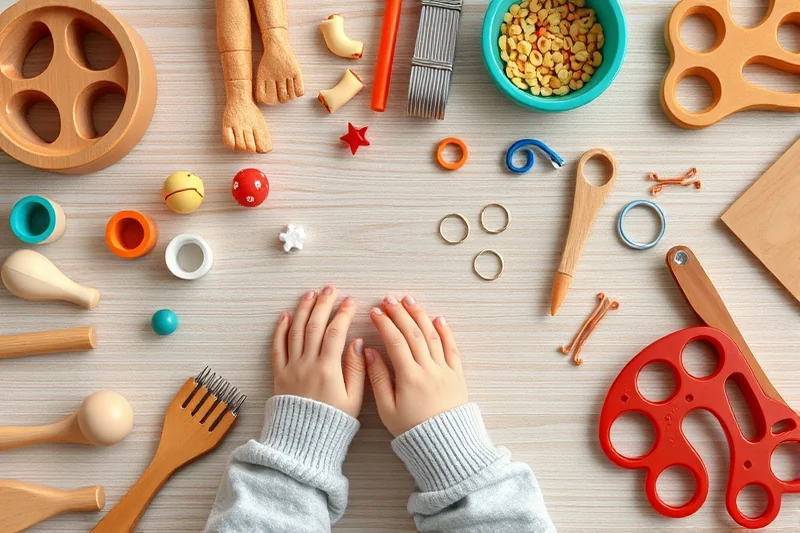
Threading activities were a game-changer for us. I remember the first time I handed my daughter a piece of yarn and a set of large buttons — she was so focused on the task that she didn’t even realize how much she was learning. The act of threading a button through a hole required precision, patience, and a lot of trial and error, but it was all worth it when she finally succeeded.
One of the best fine motor skills activities for toddlers is threading, which teaches them to use their fingers in a coordinated way. I’ve tried using different materials — from large wooden beads to pasta — and each one has helped my daughter develop her fine motor skills in a unique way. The most important thing is to provide them with the right tools, like thick needles or blunt-ended lacing cards.
Threading is not just about the physical act of passing something through a hole — it’s about building perseverance and problem-solving skills. I’ve seen my daughter get frustrated when the thread slips through the hole, but she always keeps trying, and eventually, she finds a way to make it work. It’s these small victories that make the activity so rewarding.
Building Blocks and Stacking: A Foundation for Development
Building blocks were one of the first activities I introduced to my daughter, and they became a staple in our home. She loved stacking them, knocking them down, and then rebuilding them again. What I didn’t expect was how much these simple blocks would help her develop her fine motor skills and spatial awareness.
One of the best fine motor skills activities for toddlers is building with blocks, which requires careful hand movements and coordination. I’ve noticed that my daughter’s ability to stack blocks has improved dramatically over time — she can now build towers that are much taller and more stable than she could when she was younger.
Blocks are also great for teaching toddlers about balance, symmetry, and problem-solving. I’ve seen her experiment with different shapes and sizes to see what works best. It’s not just about the activity — it’s about the learning that happens along the way, as she discovers how to make things stand up, how to fit pieces together. How to build something that is both strong and beautiful.
⭐ Classic
The original playdough recipe with flour, salt, and water for a simple, sensory-rich texture.
💰 Budget
Made with basic ingredients like flour and salt, this variation is perfect for parents on a tight budget.
⚡ Extra-Fast
A quicker version using pre-made playdough kits that can be assembled in minutes.
✨ Depth
This version adds sensory elements like sand or small objects for an added learning experience.
🥗 Light
A low-calorie, gluten-free version of playdough for toddlers with dietary restrictions.
| The mistake | Why it happens | The fix |
|---|---|---|
| Using too small of objects for threading or sorting | Using objects that are too small can be frustrating for toddlers and may lead to a lack of success, which can discourage them from continuing the activity. | Start with larger objects and gradually move to smaller ones as the toddler becomes more confident. |
| Not providing enough variety in activities | If you only offer one or two types of fine motor activities, your toddler may become bored or disinterested in practicing their skills. | Offer a variety of activities that engage different muscle groups and challenge the toddler in new ways. |
| Expecting too much too soon | Fine motor skills develop gradually, and expecting a toddler to perform complex tasks without enough practice can lead to frustration and a lack of progress. | Be patient and allow your toddler to practice at their own pace, giving them time to learn and grow. |
| Not providing enough support or guidance | If a toddler is left to figure out a fine motor activity on their own without any guidance, they may become discouraged or give up too quickly. | Offer gentle support and encouragement, and demonstrate how to perform the activity if needed. |
What You'll Need tap to check off
- 1 cup flour
- ½ cup salt
- ½ cup water
- 1 tablespoon vegetable oil
- 2 tablespoons liquid food coloring (optional)
- essential oils (optional, for scent)
Method tap a step when done
- In a large bowl, mix together flour and salt.
- Add water, vegetable oil, and food coloring (if using).
- Knead the dough for about 10 minutes until it becomes smooth and elastic.
- Store the playdough in an airtight container or plastic bag for later use.
- For a more sensory experience, add a few drops of essential oils like lavender or peppermint.
Key Facts
Best Fine Motor Skills Activities For Toddlers
Common Questions
What are the best fine motor skills activities for toddlers at home?
How can I make playdough at home without buying it?
What are the benefits of using tongs and tweezers for toddlers?
How can I encourage my toddler to practice fine motor skills daily?
References
- Foundation: Fine Motor - Child Development (CA Dept of Education) (cde.ca.gov)
- Motor Skill Activities | Summer Fine Motor Skill Activities (communitycarecollege.edu)
- Supporting Fine and Gross Motor Skills In and Out of the Classroom (extension.psu.edu)
- PDF G2104 Ages and Stages: Toddler (12-24 Months) (extensionpubs.unl.edu)
- Infant and Toddler Activity Pages: Roll the Ball (canr.msu.edu)
Cite this guide
TinyRomp (2026). Best Fine Motor Skills Activities For Toddlers. https://tinyromp.com/best-fine-motor-skills-activities-for-toddlers/
Feel free to cite or share this guide.